
Introduction
Health system transformation for public health takes more than a new platform, a cost-cutting round, or a string of isolated pilots. It means changing how an organization understands and improves the health of the people it serves.
Leaders face real pressure. CDC research found that 46% of health workers often or very often felt burned out in 2022, up from 32% in 2018.
They must connect clinical care with prevention, equitable access, workforce capability, and community conditions, all while keeping operations sustainable.
This article defines transformation, outlines its core components, lays out an implementation roadmap, and explains how to measure whether change is working.
Key Takeaways
- Connect clinical care, prevention, equity, workforce, digital tools, and community partnership instead of running them as separate programs.
- Start with frontline conditions, patient needs, and population data before choosing a solution.
- Durable change needs accountable governance, engaged clinicians and communities, and evidence-based adjustment.
- Balance financial stability against outcomes, access, trust, and workforce well-being.
What Health System Transformation Means for Public Health
A coordinated redesign, not a single project
Transformation is the coordinated redesign of structures, operating models, care pathways, capabilities, and partnerships to improve health outcomes at scale. It differs from incremental quality improvement, one digital deployment, or a short-term cost program.
No single U.S. definition exists. Two useful frames come close. CDC's Public Health 3.0 casts public health leaders as "Chief Health Strategists" working with cross-sector partners. AHRQ describes a learning health system as one that joins internal data and experience with external evidence, then puts that knowledge into practice.
Why health systems shape public health
Health systems influence prevention, chronic disease management, behavioral health, access, continuity of care, and health education. They also affect whether people can benefit from care at all. Those public health results depend on system-level change, and Batiste Advisory Group notes that piecemeal fixes rarely produce sustainable transformation.
Pressures driving urgency
- Hospital RN vacancy rate stands at 8.6%, per the 2026 NSI report
- 40% of the U.S. population (137 million people) lived in a Mental Health Professional Shortage Area as of December 2025 (HRSA)
- Fragmented transitions for high-need patients can jeopardize safety, AHRQ warns
- 44.9% of U.S. payments used advanced alternative payment models in 2024; 28.7% carried downside risk (HCP-LAN)
The Core Components of Public Health-Focused Transformation
Align with population and public health outcomes
Define the populations and outcomes you intend to improve first. Then tie enterprise strategy to prevention, avoidable illness, access, quality, patient experience, and community well-being.
Established frameworks help. IHI's Triple Aim covers patient experience, population health, and per-capita cost. The Quintuple Aim adds health equity and workforce well-being.
ThedaCare, a five-hospital, 22-clinic system, built a Community Health Action Team that works with schools on tobacco, physical activity, healthy eating, and preventive-care access.
Strengthen workforce capability and clinical leadership
Transformation fails when roles blur and people fear speaking up. Build for:
- Multidisciplinary teams with clear role ownership and interfaces
- Leadership development at executive, midlevel, frontline, and emerging levels
- Psychological safety, where team members can ask for help and learn from mistakes
- Competencies that are defined, developed, demonstrated, and validated
- Community health workers and clinicians practicing at the top of their capabilities
CDC's Community Preventive Services Task Force finds strong evidence for community health workers in team-based care. AHRQ's TeamSTEPPS offers an evidence-based framework for team performance.
Integrate data, digital health, and decision support
Interoperable data, population analytics, remote care, and patient communication tools support earlier intervention. HHS reported that TEFCA exchange grew from 10 million to more than 1 billion health records in under a year.
Guardrails matter:
- Apply HIPAA Privacy and Security Rule requirements to each specific use case
- Keep meaningful human oversight of AI, in line with AMA policy that AI supports, not replaces, physician judgment
- Check data quality before building decisions on it
- Plan for digital access gaps (Pew found home broadband in 54% of households earning under $30,000, versus 94% at $100,000 or more)
Redesign care around prevention and complex needs
Move from episodic, site-based care toward coordinated pathways across chronic disease, behavioral health, social needs, and transitions. Define ownership and escalation up front for high-need patients.
Practical steps include:
- Assign a named care lead for each high-need patient
- Set a shared care plan across primary and behavioral health
- Specify who escalates when a discharge, housing problem, or missed appointment appears
CMS reports its Accountable Health Communities model screened more than 1.1 million beneficiaries for social needs and generated over $200 million in net savings.
Build governance and cross-sector accountability
Align executives, clinicians, public health agencies, community organizations, payers, patients, and caregivers around shared priorities. Settle decision rights, funding, accountability, and escalation paths before implementation, not after something stalls.
Nonprofit hospitals already have a starting point: federal tax law requires a Community Health Needs Assessment every three years, with an implementation strategy and community input.

A Practical Roadmap for Health System Transformation
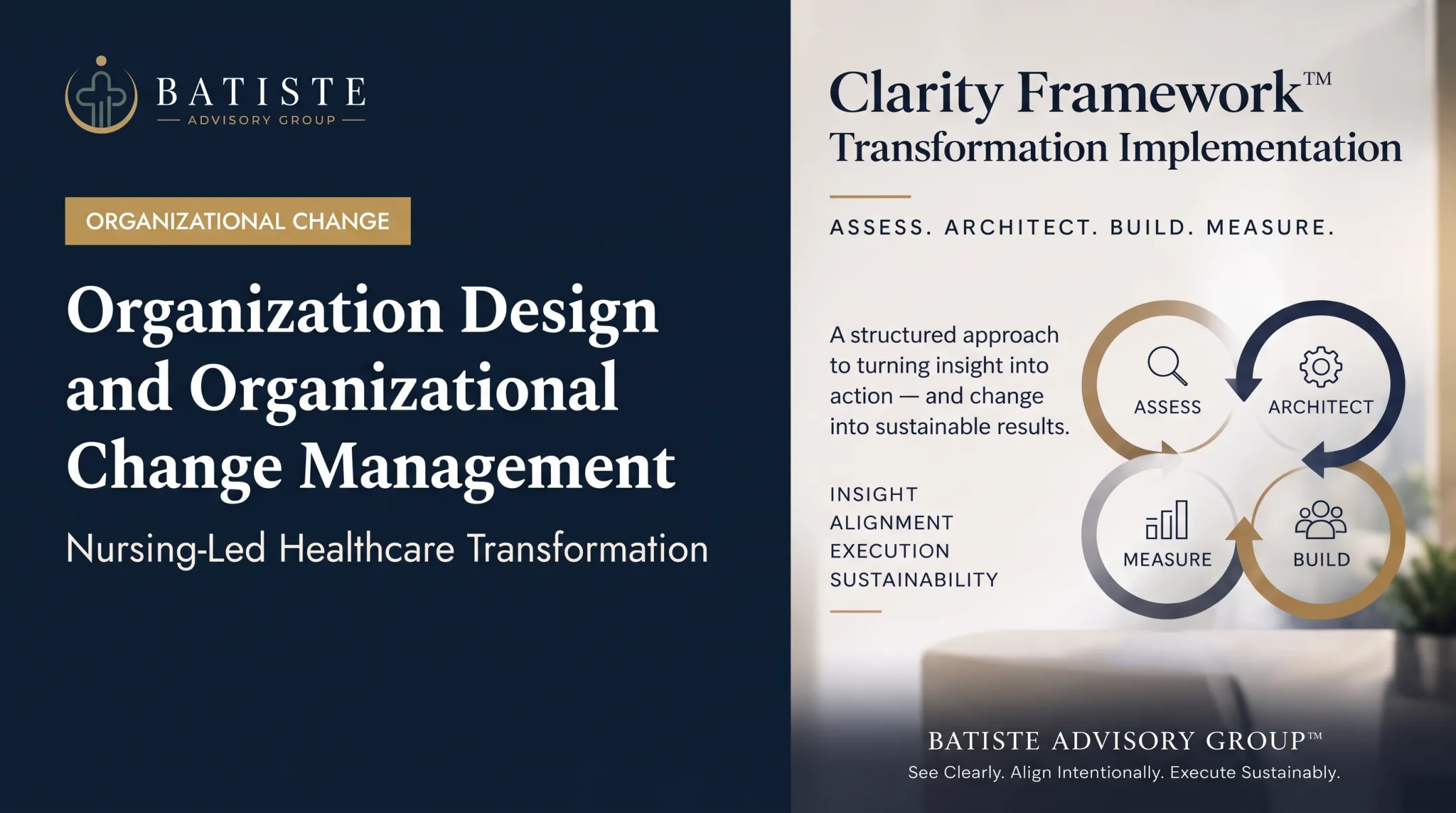
1. Establish the current-state "ground truth"
Combine performance data with frontline observation, patient and community feedback, workforce input, and care-pathway review. Look for places where reported performance differs from lived experience and where fragmented responsibility blocks progress.
Batiste Advisory Group frames this as the gap between the "Official Organization" shown in dashboards and the "Real Organization" staff experience daily. Ask whether shared governance truly influences decisions and whether frontline nurses feel safe speaking up.
2. Select a focused transformation portfolio
Rank initiatives by:
- Population need and equity impact
- Clinical value
- Feasibility and workforce capacity
- Financial sustainability
- Strategic fit
Then name what you will stop, defer, or redesign. Without that, execution capacity never appears.
3. Design the future operating model
Specify the operating model components:
- Governance, roles, and workflows
- Technology and partnerships
- Funding and referral pathways
- Performance management
Connect hospital, ambulatory, behavioral health, home-based, post-acute, and community services where relevant.
4. Implement through staged change
Start with a defined pilot or priority population. Engage affected staff and communities, train people, explain the reason for change, and watch for unintended consequences.
AHRQ's Patient Safety Learning Labs follow this logic: develop, pilot, and implement with frontline clinicians involved, while documenting engagement barriers.
5. Scale, institutionalize, and learn
Successful pilots become:
- Standard procedure and budget lines
- Leadership expectations
- Competency programs
- Accountability reviews
Run regular learning cycles so the system responds to new evidence, policy shifts, technology risks, and community feedback.

Building Equity, Trust, and Community Partnership Into Transformation
Inequalities versus inequities
Health inequalities are differences in health or access. Inequities are differences that are unfair, avoidable, and tied to social, economic, environmental, or structural conditions. A 2025 American Journal of Public Health article notes that all inequities are inequalities, but not all inequalities are inequities.
Make community voice part of design
- Patient advisory groups with real influence
- Community listening sessions
- Partnerships with trusted local organizations
- Language access and culturally responsive communication
- Public reporting on how feedback changed decisions
Design for unequal access
Do not assume every patient can navigate the system the same way. USDA reported 13.7% of U.S. households were food insecure in 2024. CDC found 14.4% of adults with disabilities lacked reliable transportation in 2022, versus 4.9% of adults without disabilities.
Coordinated support might pair a clinic visit with a transportation benefit, a food referral, and a community health worker follow-up call, all tracked in one care plan.
Evaluate who benefits
Stratify outcomes by demographic, geographic, clinical, socioeconomic, and access factors where appropriate, while protecting privacy. CMS's 2024 National Impact Assessment identified new disparities in 91 of 197 measures. When disparities appear, involve affected communities in corrective action.
Measuring and Sustaining Transformation
Build a balanced framework that covers the domains that matter for public health transformation:
- Public health outcomes and prevention
- Access, quality, and safety
- Equity, plus patient and community experience
- Workforce well-being and care coordination
- Operations and finances
Established sources include:
- CMS Meaningful Measures 2.0
- HEDIS
- Healthy People 2030 Leading Health Indicators (23 indicators)
- IHI Whole System Measures 2.0
- AHRQ Quality Indicators
IHI recommends a small set, typically 4 to 10 measures, spanning outcome, process, and balancing measures.
Track both kinds of signals. Leading indicators show early whether the change is taking hold:
- Workforce adoption
- Referral completion
- Care-plan follow-through
- Community engagement
Lagging indicators confirm whether it mattered:
- Health outcomes
- Utilization
- Avoidable harm
- Trust
When outside advisory support is useful
Dashboards can look healthy while units tell a different story. An independent, nurse-led assessment such as Batiste Advisory Group's Ground Truth Audit™ compares dashboards with frontline and community realities. It surfaces root challenges and shapes a practical transformation roadmap.

It is most useful before a major investment, or during transition, integration, redesign, expansion, or recovery. Deliverables typically include:
- A readiness report
- A financial impact analysis and roadmap
- An executive readout
Any later implementation is scoped separately based on findings and client priorities.
Frequently Asked Questions
What is the difference between health inequalities and health inequities?
Inequalities are measurable differences in health or access. Inequities are unfair, avoidable differences shaped by social or structural conditions, as CDC's health equity guidance describes.
What are some examples of complex care needs?
Examples include multiple chronic conditions, behavioral health needs, functional disability, medication complexity, housing insecurity, and other social needs. Frequent transitions between care settings add risk.
What are some examples of digital health?
Telehealth, remote patient monitoring, patient portals, electronic health records, health information exchange, population health analytics, and clinical decision support all qualify.
What are the 10 factors that affect health?
No single authoritative ten-factor list exists. Frameworks group determinants into social and economic environment, physical environment, and individual behaviors and characteristics. Healthy People 2030 uses five social determinant domains.
What does health system transformation mean?
It is coordinated, organization-wide change to care delivery, operating models, workforce, partnerships, technology, and accountability, aimed at better population and public health outcomes.
How can health systems measure transformation for public health?
Use a balanced set of clinical, prevention, access, equity, experience, workforce, community, operational, and financial measures. Review results by population group and track them over time.